Most guitar players don’t get stuck because licks are too hard. They get stuck because they reach for the wrong ones first… the flashy, ten-notes-a-second stuff that takes months to clean up.
These licks are part of our wider guitar riffs and licks collection, if you want the full picture.
So here’s a different starting point. Fifteen easy guitar licks, plus a Knopfler bonus to grow into, every one built out of the minor pentatonic scale and a few simple moves you already half-know. Each lick has a short video and a tab you can follow along with. They’re sorted easy to hard, so start at the top and work your way down as you get comfortable.
You’ll notice something pretty quickly: a great-sounding lick is usually three or four notes doing one clever thing. That’s the whole secret. Let’s play some.
Easy guitar licks to start with
These five are the friendliest. One position, one little technique each, and they sound like real music almost immediately.
1. A Sweet Minor Third (A minor)
This is the one I’d hand any beginner first. It lives in A minor pentatonic, right in the spot where box 1 meets box 2, and that little overlap is one of the handiest places on the neck to know. You slide into the 9th fret with your third finger, work down through the pattern, and finish with a touch of vibrato. I hybrid-pick it (pick on one string, finger on the next), but a plain down-pick works just as well.
2. The Pentatonic Repeat (A minor)
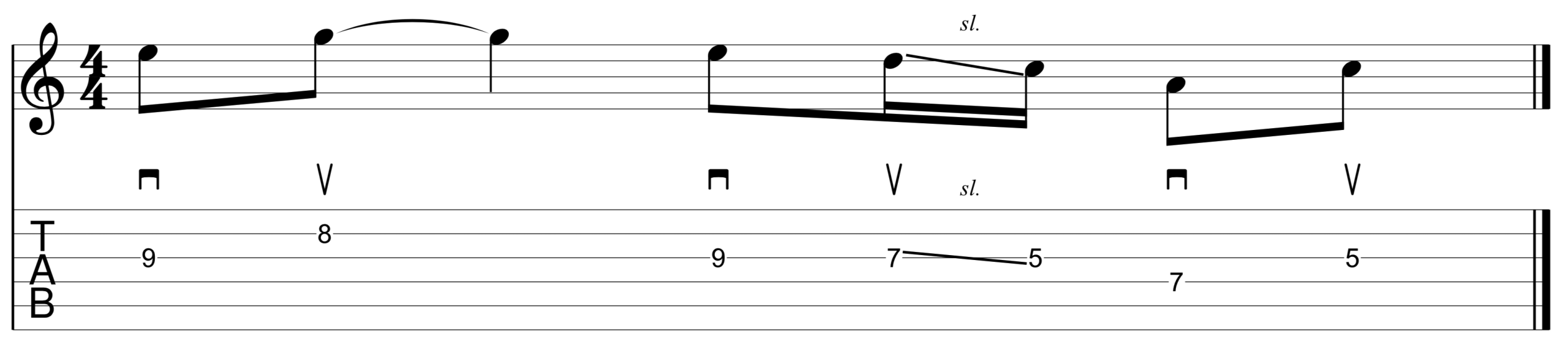
Three notes from A minor pentatonic box 1, with a pull-off, and then the same little shape walks itself down the scale. This should be back-of-the-hand stuff… start on the 8th fret of the second string, pick-and-pull-off, repeat. Because it’s really just a pattern, you can slide it anywhere down the scale and it keeps working.

3. The Open-String Bend (E minor)
Open strings are a beginner’s best friend. They ring out while your fretting hand resets, so half the lick plays itself. Early on you bend a string up a whole tone and let it back down (pick the note first so your ear learns the target), then pull off to the open strings and land on an E7 chord. If you’ve never bent a string before, this is a friendly place to start.

4. The Blue Note Double Stop (A minor)
Here’s where things get bluesy. You sound the ‘blue note’, the flatted fifth, that sneaky slightly-wrong note, and the trick is you don’t hang on it. You introduce that dissonance and immediately slide your pinky up to resolve it, then rock a double stop back and forth. It’s out of box 2 in A minor, and the whole feeling is creating that tension and letting it go.

5. Sliding Sixths (C major / A minor)
Sixths are pairs of notes that give you that warm, sweet, almost country sound you’ve heard a thousand times without knowing what it was. You play them on the second and fourth strings out of C major (same thing as A minor), and the core move couldn’t be simpler: start one fret below where you want to be and slide in. I hybrid-pick the pair so both notes glide up together cleanly.

Stepping it up
You’ve got the basics now. These add a second technique or a bit more movement, but nothing here is out of reach.
6. The Devil’s-Note Blues Lick (B minor)
This one opens with attitude… a quick rake across the strings that catches the flatted fifth, the old ‘devil’s note’. It’s discordant on purpose, so you brush right past it and land on the B, let it ring, then finish with a little bend. It all comes out of B minor pentatonic, box 1. Pair it with a few blues guitar licks and you’ve got the start of a real solo.

7. Bend and Slide
Now we stack two moves… a full-tone bend (target the note two frets up so you bend in tune) and a slide up the neck with a little vibrato at the top. Take the slide slow at first… it’s easy to overshoot when you’re jumping a few frets. This one sits in box 2, and stacking small techniques like this is exactly how longer licks get built.

8. The Descending Major Run (C major)
Sometimes the scale itself is the lick. This walks down the major scale in a ‘two notes back, one forward’ pattern, and it sounds way fancier than it is… you’re just playing the scale in order, in a pattern. Learn the scale first or this is random notes; know the scale and it makes total sense. There’s a shorter version and a slightly longer one, and the tab has both.


9. Sliding Fourths (A major)
Fourths are another pair-of-notes trick, brighter and more open than the sixths back in #5… I actually picked this one up from Colin James. You slide a little shape up two frets out of the top of the A major pentatonic, then bar the top two strings.
Want it even easier? On acoustic, if you’re strumming in G, just slide your third and fourth fingers from the 3rd fret up to the 5th and back. Same idea, totally different feel. That’s the whole game right there: one move, played in new spots, quietly becomes ten licks.

10. The Three-Position Run
This is your first taste of getting out of the box. It travels down through boxes one, two, and three of the pentatonic minor using slides, so it quietly teaches your hand that the scale keeps going the whole neck. You’ll sometimes slide into the top note and sometimes pre-bend into it, with a few tiny quarter-tone bends for blues flavor. That lesson, the neck is all connected, is worth more than the lick itself.

11. More Sliding Double Stops (G major)
Liked the double stops in #5? Here’s the idea again in G major, this time on the second and third strings. Grab the little two-finger shape, slide it up two frets, and play around… you can even bring the open second and third strings into it. One shape, lots of spots.

A few to grow into
These lean on hammer-ons, bends, or a bit of theory. They look harder than they are, so give them some extra time. Get them clean and you’ve come a long way from #1.
12. The Bluesy Flatted Third (A major)
This one comes straight off an A major chord. You slide into the root, then ‘flat the third’, come into the third of the chord from a fret below, and you get that classic bluesy ache. There’s a little half-step bend in the second half before you resolve right back to the A. Try that flatted-third move over any major chord; it works all over the neck.

13. The Repeater (B minor)
This is a speed trick disguised as a lick. You lock your first finger on the 7th fret, pick once, hammer on, pull off, then hop to the next string… pick, hammer, pull, pick, repeat. The secret is keeping your pick moving only between the two strings, never around them, so it pours out fast with almost no effort. The first run-through feels clumsy and the tenth feels automatic.

14. Hammer-On Double Stops
Double stops add a ton of character… that extra note pushes a little more signal through, and with some crunch it breaks up in just the right way. You bar two strings, pick them, and hammer on with your third finger right after, then move the shape down the scale and do it again. Hybrid-picked, fast little pulses. One of my favorites.

15. The Diminished Move (Dim7)
I’ll be honest… this one’s less a lick and more an idea, but it’s a cool one. You take a single diminished-7th chord shape and move it up in three-fret jumps, and because of how the chord is built, the same shape keeps producing a fresh version of itself. It’s slippery and dramatic, and it just begs to resolve down to A minor. Pull single notes or pairs out of it and you’ve got an instant solo move.

Bonus: A Sweet Mark Knopfler Lick
No tab on this one, and that’s the point. It’s inspired by the lick Mark Knopfler plays in the second verse of ‘Sultans of Swing’, the one most people overlook because it sounds so melodic you’d never guess it’s just the A chord. The whole idea is triads: little three-note chord shapes, with a suspended fourth, played as a lick instead of a strum. Let your ear lead, and play it against the slow jam track here:
How to actually make these stick
Don’t try to learn all fifteen at once. Pick two or three you genuinely like the sound of and live with them for a week.
Play each one slowly enough that it’s clean. A lick played slow and clean beats the same lick played fast and sloppy every single time… and fast comes on its own once clean is locked in.
Then do the thing almost nobody does: play your lick over a backing track or a song. A lick sitting by itself is an exercise. The same lick dropped into an actual chord progression is music, and that’s when your ear starts to learn where these things belong. That jump from playing licks to weaving them into real solos is exactly what we build, step by step, inside Tasty Riffs & Solos.
Frequently asked questions
What are the easiest guitar licks for beginners?
The easiest guitar licks for beginners use one position of the minor pentatonic scale and a single technique, like a pull-off or a slide. The ‘Sweet Minor Third’ and ‘Pentatonic Repeat’ above are good first licks because the pattern repeats and the moves are simple.
What scale are most guitar licks based on?
Most rock and blues guitar licks come from the minor pentatonic scale, a five-note scale that sounds good over almost any blues or rock progression. Every lick on this page is built from it. Learning the pentatonic scale first makes new licks much faster to pick up.
How do I memorize guitar licks?
Learn one lick at a time, play it slowly until it’s clean, then play it over a backing track in the same key. Connecting a lick to real music, instead of drilling it on its own, is what moves it into long-term memory.
Can I play these easy guitar licks on an acoustic guitar?
Yes. Every lick here works on acoustic or electric. Bends and slides take a little more hand strength on acoustic, so start slowly, but the notes are exactly the same.
How many guitar licks should I know?
There’s no magic number. A handful of licks you can play cleanly and drop into a song is worth far more than fifty you’ve half-learned. Master a few of these, then add new ones as you go.