
If you’ve never tried hybrid picking before, this lesson will get you started with a beautiful-sounding pattern that shows you exactly why this technique is worth learning. Hybrid picking opens up a whole new world of guitar sounds that you simply can’t get with a pick alone.
What Is Hybrid Picking?
Hybrid picking is simply using your pick just like you normally would, but adding in the use of your three remaining fingers (middle, ring, and pinky).
You keep all the benefits of using a pick—nothing changes there—but you add in some of the benefits of fingerstyle playing. The biggest one? You can pick multiple places at once.
Your pick is always limited to being in one place at one time. If you want to play more than one string at once, you need to strum them. But sometimes you simply can’t strum the strings—like with widespread double stops where there are strings in between that you don’t want to sound.
That’s where hybrid picking becomes essential.
The Basic Finger Assignment
For this pattern, we’re using one finger per string:
- Pick: Bass strings (strings 4-6, depending on the chord)
- Middle finger: 3rd string
- Ring finger: 2nd string
- Pinky finger: 1st string
You don’t always have to use this assignment with hybrid picking, but for this particular pattern it works perfectly.
The Chord Progression
We’re using four chords, each lasting two beats (half a bar):
- Cadd9 (root on 5th string, 3rd fret)
- Em7 (root on 6th string)
- Dsus4 (root on 4th string)
- D major (root on 4th string)
You need to know where the root note is for each chord because that’s what you’ll play with your pick.
The Basic Pattern
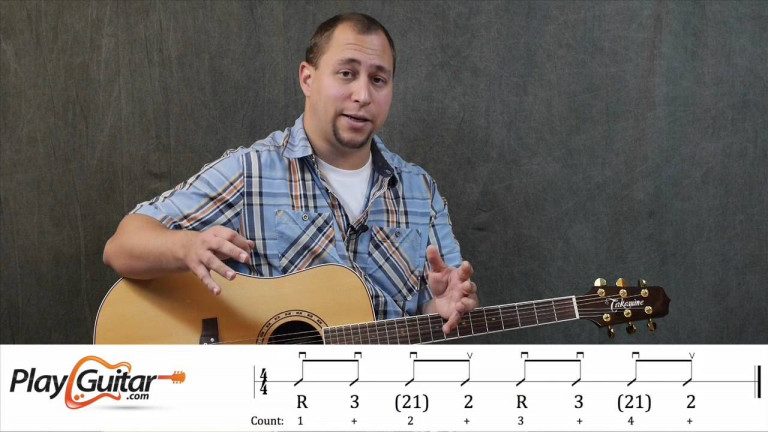
Here’s the picking pattern for the first three chords (Cadd9, Em7, and the first half of the bar):
1 and 2 and 3 and 4 and
- Root note + 2nd string (pick and ring finger together)
- 3rd string (middle finger)
- 1st string (pinky finger)
- 3rd string (middle finger)
That simultaneous attack of the root note and 2nd string is what creates that beautiful depth. You’re playing two notes at the exact same time—something you can’t do with just a pick.

The Pattern Variation on Dsus4
When you get to the Dsus4, we change the pattern slightly. This is where we’re playing off the suspended 4th resolving down to the major 3rd, and I wanted that 3rd to hit right on the main beat.
Here’s the modified pattern for Dsus4 ? D major:
- Root note + 2nd string (same as before)
- 3rd string (middle finger)
- Root note + 1st string (pick and pinky together) ? This is the change
- 2nd string (ring finger)
- 3rd string (middle finger)
By playing the root and 1st string together on that third beat, the major 3rd hits exactly where you want it rhythmically. You can try it both ways and decide which you prefer—it all depends on how you want the rhythm to work in your playing.
How to Practice This Pattern
Start slow. Really slow. The play-along examples below range from 40 BPM to 65 BPM:
Play Along Examples
40 BPM
45 BPM
50 BPM
55 BPM
60 BPM
65 BPM
Focus on getting those simultaneous attacks clean—where the pick and finger hit at exactly the same time. That takes practice, but it’s what creates the depth and fullness that makes hybrid picking sound so good.
Taking It Further
Congratulations—you’ve just learned your first hybrid picking pattern! This is just the beginning. Hybrid picking opens up tons of possibilities for arpeggios, country chicken picking, fingerstyle rock, and complex rhythm patterns.
If you want to dive deeper into hybrid picking with more patterns and applications, check out my Rhythm Player’s Guide to Picking course. There’s an entire section dedicated to hybrid picking with lots of different patterns and techniques.
Questions about hybrid picking? Drop a comment below!
Hi Jonathan, Excellent lesson. Waiting for the course release
That's a start for a great journey – I hope!
Working on it.
This is a picking pattern I've used for some time, but always with my thumb instead of a pick. I've never been comfortable using the pick as most of my picking patterns have me use my first finger that wouldn't be available if I'm holding a pick. I'll have to give it another go and see what happens. Thanks for the lesson.
Have never tried hybrid picking. Thanks for the tutorial.
I can't decide which I like more, but I love the calming effect I feel from this pattern. It's reminding me of a tune i heard a long time ago and it sounds similar to this. But like so much music it haunts me, not knowing what the song is. I guess it doesn't matter in the long run. I'll enjoy learning this pattern at the different speeds. Maybe the title of the song will come to me then.
Nice to have a short approach like this.. not so intimidating as a page or a full song worth to start with!
That is alot of fun. I'd love to learn a little about the chord progressions.
Good starter lesson, Jonathan. I will be working on this. Sorry, I used the wrong email for my previous post.
thanx for doing this