
Everyone knows the standard E minor chord — two fingers, six strings, done. It’s one of the first chords you learn, and most players never think about it again. But just like there are dozens of ways to modify a G chord, there are voicings of E minor further up the neck that sound completely different — wider, more open, almost like a different chord entirely.
In this lesson we’ll look at two E minor voicings that use open strings mixed with fretted notes higher on the neck. They have a big, spread-out sound that works beautifully in slower songs or as a contrast to your standard open chords.
Voicing 1: The Wide Spread (7th Fret)
This voicing uses all six strings:
- 6th string: open E
- 5th string: 7th fret (E) — use your ring finger
- 4th string: 5th fret (G) — use your index finger
- 3rd string: open G
- 2nd string: open B
- 1st string: 7th fret (B) — use your pinky
The magic here is the spread. You’ve got a low E on the bottom, notes in the middle of the neck, open strings ringing in between, and a high B on top. It creates a wide, spacious sound that a basic E minor at the second fret can’t match.
Try playing a regular open C chord, then switch to this E minor voicing. The contrast between the compact C shape down low and this wide E minor up the neck sounds fantastic — like two different guitars playing together.
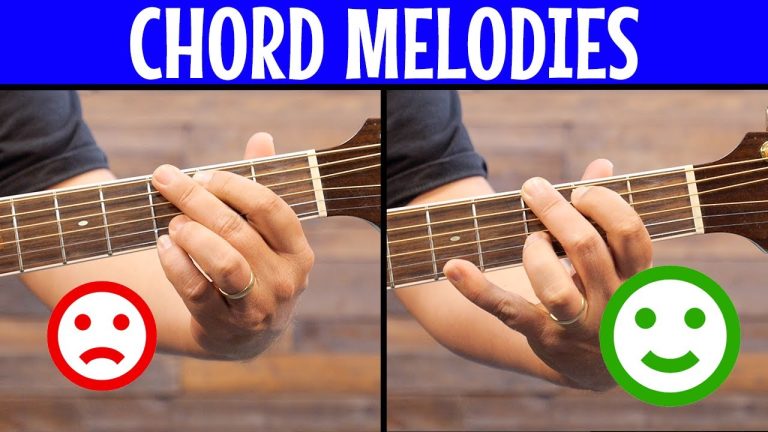
Voicing 2: Different Hand Position
The second voicing uses similar frets but a different finger arrangement. The exact notes shift slightly, giving you a variation that sits differently under your hand and has its own character. Both voicings use the same principle: mixing fretted notes at the 5th-7th fret area with open strings to create a wide harmonic spread.
When to Use These
These aren’t replacements for your standard E minor — they’re additions to your vocabulary. Use them when:
- You want contrast — follow a standard open chord with one of these higher voicings to create a sense of movement
- You’re playing with another guitarist — one player stays in open position, the other plays these upper voicings. This is the same concept behind two-string chord voicings — separating register so two guitars don’t compete.
- Slower songs or intros — the wide spread sounds especially good when you let each string ring out
- Fingerpicking — the open strings mixed with fretted notes create a harp-like effect when picked individually
Once you start thinking about chords as movable, flexible shapes rather than fixed positions, the whole fretboard opens up. Creating your own chord voicings takes this idea even further.

Sweet! Love those spread-out octaves to give added richness when it suits the mood!