
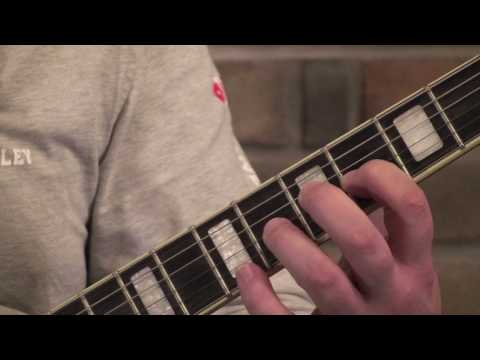
Once you’ve got the minor pentatonic under your fingers, the A major diatonic scale is a great addition to your toolkit. In the video above, we’ll look at the pattern, where it sits on the neck, and — more importantly — how it connects to scales you already know.
The major scale has a brighter, happier sound than the minor. You’ll recognize it immediately when you hear it.
Same Notes, Different Starting Point
Here’s something that trips a lot of guitarists up: the major and minor diatonic scales share the same notes. They’re not two completely different things — it’s the same set of notes, just starting from a different place.
The A major scale and the C# minor scale, for example, use identical notes. They’re called relative scales. The major scale starts on one note; its relative minor starts three frets down.
So if you already know the A diatonic minor scale, you actually already know most of the A major scale — you’re just playing it from a different root note.
This works the other way too. A major’s relative minor is F# minor. Same seven notes — F#, G#, A, B, C#, D#, E — but when you start on F# and treat that as home base, the whole mood shifts from bright and uplifting to darker and more intense. If you ever need to solo over an F# minor progression, you already have the notes under your fingers from this A major pattern. That’s the power of understanding relative scales: one shape, two completely different musical contexts.
How This Helps You Solo
This relationship is really useful when you’re soloing. Say the song is in C major. You can solo using the C major scale — or you can use the A minor scale (its relative minor) and get the same notes, different flavor.
Knowing both gives you more of the fretboard to work with. Instead of being stuck in one box, you can shift between the major and minor positions and cover a bigger range of the neck.
The Pattern on the Neck
In the video, we’re looking at the A major diatonic pattern. The key thing to practice is recognizing where the root notes fall and how this shape connects to the minor shape you already know.
As Jonathan shows in the lesson, the major scale position sits higher up the neck relative to its minor counterpart. Once you can see both shapes and understand how they’re related, the fretboard starts to make a lot more sense.
Major Scale vs. Pentatonic — When to Reach for Each
Both are valid. The choice comes down to the feel you’re going for.
Major scales tend to sound bright and uplifting. Minor scales have more of an edge or emotional weight to them. Most rock and blues playing leans minor, which is why the pentatonic minor gets so much use. But if you’re playing over a major chord progression and want that brighter sound, the major scale is where you go.
The pentatonic is your “safe” scale — every note sounds good over the right chords, so you can play freely without worrying much about landing on a sour note. The full major diatonic gives you two extra notes (the 4th and 7th degrees), and those notes add color and movement. The 7th degree in particular has a strong pull toward the root — that’s why melodies built on the major scale feel like they’re going somewhere, while pentatonic licks tend to float more freely.
A practical way to feel this: play an A major chord and solo over it using just the A major pentatonic. Then switch to the full A major diatonic and notice how the extra notes give you more options for building phrases that rise, fall, and resolve. Neither approach is better — they’re different tools for different moments.
Learning both means you’re not locked into one sound.
Keep Building
If you haven’t already worked through the A diatonic minor scale, do that first — it’ll make this lesson click faster. And once you’ve got both shapes down, the pentatonic scale is worth revisiting with fresh eyes. You’ll start to see how all three patterns overlap.
For a full breakdown of which scales to learn and in what order, the guitar scales guide maps it all out.
Hi Jonathan.
Another great lesson,I missed not having the fretboard diagram that you usually show.Looking forward to next week.
Thanks Frank.
The fretboard diagram would have helped the guys who are new at this 🙂
Hey Jonathan I just recently got you “Unlocking I – IV – V”
and I really like it I have not had time to go through the entire DVD but what I have watched I like. Thanks for helping so many learn more about the Guitar. I understand the Pentatonic Notes but I have trouble with the Diatonic notes.
Anyway thanks a lot I will order more from you later.
Bruce Templeton
The Bricks are Back,–Go Johnny Go.!!!!
I missed that Background, it`s Realistick…
Thank You for the clear presise lesson, you`re a Good
Man Jon–Thank You.!!!!
Wal of the`RAPIDS“CEDAR`that is………
it very interesting, tks
[…] Tune the treble (high) E string to an A440 tuning fork by holding your finger on the 5th fret, then tune the open B string to the open treble E string ? listening to the interval of a fourth.diatonic major scale […]
I am now working on the watch and learn lessions by Jody Worrell and Peter somthing. I took a few months of lessons from Jody in 2088. He is a friend and help me a lot. I’m now working on his book which is giving me leads to many of the best blues songs ever played. I am going thru them slow. Each one i get down, i pick up riffs i can use in other places.Before i found watch and learn, i started using your stuff. Even though i have not ordered anything from you lately, I’m still cheching your stuff almost daily. I am white but i played with rymthem and blues band in the 60’s before i went in the military. How can you help me. I want to learn more theory, and i apprieciatly your free lessons. I will buy but i want to make sure your stull will help me. Dwayne Honea
Hi Dwayne, that’s the way to do it – learn riffs from songs and then add them to the toolbox and use them elsewhere. My Unlocking I IV V and Guitar Scale Patterns lessons really dig into the theory, but from a very practical standpoint. I’d encourage you to check them out, as I do have a 100% satisfaction guarantee. Cheers.
[…] This song starts with an acoustic guitar and quickly becomes an up-tempo piece.diatonic scale […]
Great video. I’m glad you mentioned about that relative minor trick. Helps a lot. I just don’t know the minor scale. Will the pentatonic minor scale work as a relative minor of the major scale?
Hi Justin, yes, you can use the pentatonic minor as the relative minor, that will work just fine.
thank you for the pentatonic scale.