
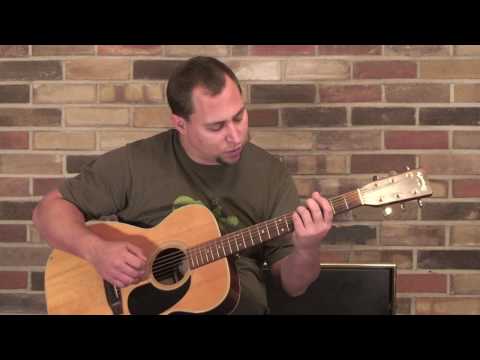
Drop D tuning is one of the easiest alternate tunings to learn because you only change one string. Lower your 6th string (low E) down one whole step to D, and you’re there.
The result? Heavier power chords, easier bass movement, and a rich low-end that standard tuning can’t match.
How to Tune to Drop D
Standard tuning is E-A-D-G-B-E. In Drop D, it becomes D-A-D-G-B-E.
To tune:
- Play the open 6th string (low E)
- Turn the tuning peg to lower the pitch
- Stop when it matches the 4th string (D string) played open
- They should sound an octave apart
Quick tip: Use your tuner. The low D should read exactly one whole step down from E.
Why Use Drop D?
1. Power Chords with One Finger
In standard tuning, power chords require two fingers (root on 6th, fifth on 5th). In Drop D, you can play them with one finger barred across strings 6-5-4.
For example:
- D5 power chord: Strings 6-5-4, all on the 12th fret
- C5: Strings 6-5-4, all on the 10th fret
- G5: Strings 6-5-4, all on the 5th fret
This makes fast riff work much easier.
2. Rich Low D Note
That low D string gives you an extra bass note that sits below standard tuning. Great for folk fingerpicking, rock riffs, or any time you want a deeper, fuller sound.
3. D Major Drone
Keys revolving around D major (D, G, A) work beautifully because you can let that open low D ring under everything. It creates a natural drone that ties the whole progression together.
Chord Shapes That Work
Most open chords still work, but anything using the 6th string needs adjustment.
D Major:
- Works perfectly (you now have a low D bass note!)
- xx0232 becomes beautiful and full
G Major:
- Standard G shape doesn’t work (the 6th string would be wrong)
- Try: 520033 (like an Em shape moved up)
- Or finger it: 5×0033
A Major:
- Standard A shape works fine: x02220
- Can also add the low D: 002220
C Major:
- Standard C works: x32010
- The 6th string is already muted
Drop D vs D Standard
These are different tunings:
Drop D: Only the 6th string drops to D (D-A-D-G-B-E)
- Most chord shapes still work
- Only need to adjust chords using the 6th string
D Standard: All strings drop one whole step (D-G-C-F-A-D)
- All your chord shapes move up two frets
- Heavier, darker overall sound
- More common in metal
Drop D is easier to switch to and back from standard tuning. D Standard requires relearning or transposing everything.
Keys That Work Best
Drop D excels in these keys:
- D major (obviously)
- G major (the fifth of D)
- A major (the fourth of D… or is it the fifth? You know what I mean)
- D minor and relative minor keys
The common thread: they all share that D note, so the open 6th string fits naturally.
Getting Started
Try this simple progression:
- D major: xx0232
- G major: 520033
- A major: x02220
Let that low D ring on the D and A chords. You’ll immediately hear why this tuning is worth exploring.
Related: Check out the lesson on D form triads for more ideas in this tuning.
I enjoyed your exhibition with drop d– I had forgotten it,except it is also used on the banjo I believe– I now will have some fun using it . Ron Towle
Send me the triad lesson please
Hi Wayne – Click here for the triads lesson.
thx for the drop d tuning…kinda fun.
good lesson.
thx for the drop d tuning…kinda fun.
Send me the triad lesson please
Hi Wayne – Click here for the triads lesson.
I love the lessons,this is my new E-Mail Add.scottyd@frontier.com
I would love to see more on alternative tunings if you wouldn’t mind. I get so confused with it and want to learn this.
Thanks alot.
Hi Jonathan.
that was a great lesson,it looked like you were enjoying doing it.
Thanks Frank.
I have a question Jonathan. It is simple but I have never really heard it yet, but then again the memory doesn’t work like it used to lolol.
When you are tuning basically, does that fall under the G chord, or C chord tuning? Like tuning to the key of E, but for just basic tuning what would it fall under?
Thanks for all your efforts.
Hi Jesse, standard tuning isn’t technically in any particular key, if that’s what you’re asking.
Some of the open tunings will put you in a particular CHORD, when strummed open, however that chord could still be used in multiple keys… for instance an open G major tuning would give you a G major chord, which could be in the key of G, C, and D and more… hope that helps!
Thank you for your response, but I have a question that needs clarifying here.
So am I understanding this properly? If I tune it to the open G major, then could I get away with not even using my chording hand to play the G chord, but only use the chording hand to play the D, or C if I am tuned to the open G, and if I am playing in the key of G.
Thanks For your patience
Jesse
Sorry to be a pain in the whatever. But to tune it in G chord, does this mean I can strum without using my chording fingers for the G chord, and only use the chording fingers for the complimentary chords?
I hope I ain’t driving you crazy in this, but this has really grabbed me at this point as it is something I haven’t been involved with yet, or had any explanation in it. Yet, this tuner I got you can tune it to any chord pretty well.
Thanks ever so much for all your help.
Hi Jesse – yeah, that’s right. You can do it a few different ways, but probably the most common is D G D G B D. Here’s a video my friend made on the topic:
http://www.youtube.com/watch?v=qEwuUzk_P20
when ya tune the rest of the guitar is tuned in e, from lowest to highest ur strings should be, D,A,D,G,B,E, tune your bottom e down a whole step to D
really enjoyed the drop d exercise, i’ve been fooling with alternate tunings for years, a song i can think of right off the top of my head in drop d would be arkansas traveler, and that bass drone really resonates throughout the song,
Jonathan
Thanks for directing me to that video. It makes things clearer to me now about this tuning area.
You help so many people in this, and I really appreciate it big time.
I wouldn’t really know how to modify a chord in different tuning. Not real big on theory. But everything sounded great to me in drop d.
Maybe you might want to do a video on drop c tuning. I’ve tried that using the “standard” chord formations and it sounded great. I really enjoyed it. However, the proper way to make chord fingerings in drop c is probably really complicated.
thanks for the video
God bless!!
yeah!drop D like tool songs,my fav band!this tuning is awesome,& 4 those who find metal riffs on standard tuning a bit hard,use this tuning cuz just by holding the same fret on the 4th,5th & 6th strings,u get the sound of the power chords of the standard tuning.but sadly there aren’t alot of scales u can use with this tune,just D & B,& sometimes E.but fun tuning
Thanks Jonathan I’ve been working on Colin’s blues course that he gave me about scales, but I really needed some help on chords. Trying to figure all this stuff out by ones self is very difficult. So I really appreciate all the help I get from your videos, wither you are teaching us new things or just showing us different things to try.